Google is building a data center in Kronstorf with up to 500 MW. But a data center in Austria isn't automatically sovereign infrastructure. Who can pull the plug on Europe's AI factories – and what does sovereign AI actually look like?

Matthias Allitsch-Wutte · GEKI founder
26 August 2026 · 9 min read
Google is building a huge AI data center in Austria. In Kronstorf in Upper Austria, operations are set to start in 2027 – initially with up to 150 megawatts, with up to 500 megawatts planned at full build-out. Google explicitly names the rising demand for cloud and AI services as the reason for the project.
That is an enormous scale – and it’s fair to debate what to make of it: an opportunity (investment, jobs, modern infrastructure in the country) or a risk (high power and water demand, further dependence on a US hyperscaler, value creation that largely flows elsewhere). But one thing it clearly is not: sovereign AI for Austria or Europe.
This article looks at the AI value chain and what it means to be “sovereign” – and what you have to do so that no non-European third party can pull the plug on enterprise AI or view the data it processes.
Today, companies use AI for research, text or summaries. Tomorrow, AI agents work directly with ERP systems, corporate knowledge, software, cybersecurity and production processes. A tool turns into infrastructure – and when AI becomes critical infrastructure, the factories that produce this AI become critical infrastructure too.
Then the question “Which model is the best?” is no longer enough. We also have to ask:
Will our AI still work tomorrow if someone outside Europe decides that it may no longer work?
An AI factory is the production plant behind every AI application. It turns electricity, hardware and software into tokens – the compute units from which answers, agents and automation are made:
Data center → GPUs → models → inference software → AI applications
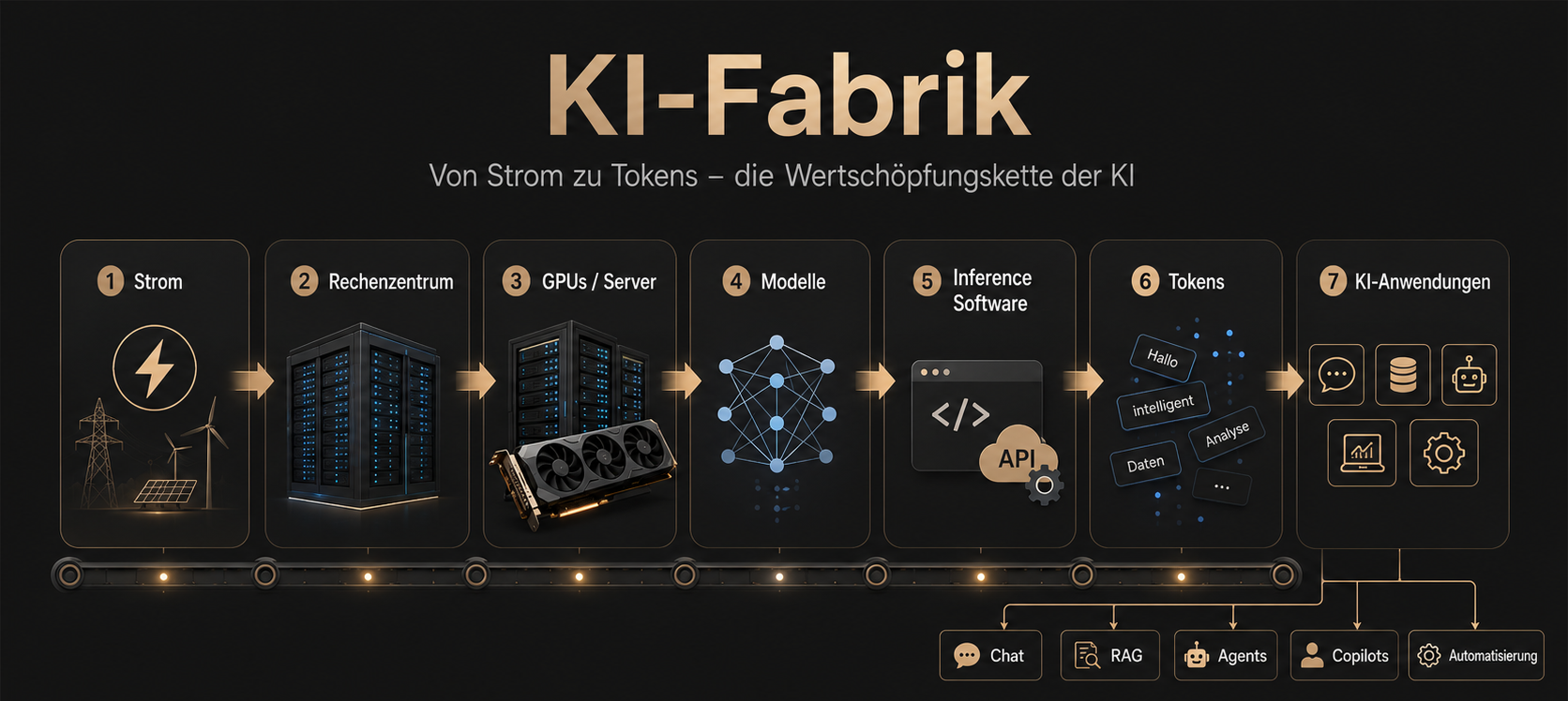
Electricity, hardware and software become the tokens that power AI applications.
Whoever operates this factory controls not only the cost but also the availability of the AI – and thus whether an application still runs tomorrow.
This value chain is international: NVIDIA and AMD develop leading GPUs in the USA, ASML from the Netherlands supplies key machines for chip production, TSMC manufactures many of the most modern chips in Taiwan, and Samsung and SK Hynix supply the high-performance memory – the VRAM on the GPUs. No country today can build a modern AI factory entirely on its own – nor does it have to, because sovereignty does not mean self-sufficiency.
The decisive question begins after procurement: who owns the GPUs, where are they located, are the model weights available locally, who controls the software stack – and does the AI need the permission of an external provider anew every day so it keeps running? A global supply chain is fine. Permanent external dependency is not.
This point matters to me personally. I worked at AWS myself for a long time and I know how these companies think: AWS, Google and Microsoft want to sell good products in Europe, generate revenue and keep their customers satisfied long-term. No hyperscaler wants to suddenly shut off the service for a good enterprise customer. That is not what sovereignty is about.
It’s not about bad intentions. It’s about jurisdictions. A US company is subject to US law. Export controls, sanctions, courts or authorities can force decisions that a company might not make on its own from a business perspective. The decisive question is therefore not “Do I trust AWS, Google or Microsoft?”, but:
Who has the last word in case of conflict?
In 2026, several incidents showed that this question is not theoretical.
Only a few days after the release of Claude Fable 5, a US export-control order led Anthropic to suspend access to Fable 5 and Mythos 5. The servers worked, the models worked, and Anthropic did not want to lose its customers. And yet model access could be switched off in seconds – by a political decision, not by the customer. Who decides, when it matters, who gets access to which models?
While analyzing a real cyberattack, the guardrails of hosted frontier models blocked parts of the legitimate forensic work. Hugging Face switched to GLM-5.2 as a locally operated open-weight model and was able to continue the analysis – the attack data stayed on their own infrastructure. The question behind it: who decides, when it matters, what my AI is allowed to do?
An analysis of Grok Build showed that, in the tested version, complete Git repositories including history were transferred to external cloud storage. The case shows: with externally operated AI, a company doesn’t automatically control every data flow. And in the future this won’t only be about prompts, but about source code, documents, customer data, credentials and complete business processes.
The US CLOUD Act also shows this difference. It does not mean US authorities can access European data at will – that requires a legal process. But US companies can, in principle, be obliged to hand over data in their “possession, custody or control” – even if it is physically stored outside the USA. That is why the sentence “Our data is in Frankfurt” does not yet answer the entire sovereignty question.
The EU is addressing this problem too: Article 32 of the EU Data Act requires data processing services to take measures against certain third-country governmental access to non-personal data held in the EU. So the storage location alone is not enough – what also matters is who controls the infrastructure and which law applies.
Today, European providers hold around 15 percent of the European cloud infrastructure market – in 2017 it was still 29 percent, while AWS, Microsoft and Google together account for around 70 percent. Now AI is arriving as the next infrastructure wave, and with it, it is being decided right now who owns the infrastructure on which Europe’s AI will run in the future.
The European Commission is already responding. Its new Cloud Sovereignty Framework considers not only the data location, but among other things legal, operational, technological and supply-chain sovereignty. The core is the same: can the infrastructure keep operating independently if a non-EU actor fails or blocks access?
There is so far no generally accepted, official EU definition of “sovereign AI”. The EU approaches the topic through its Technological Sovereignty Package (including the Cloud and AI Development Act and Chips Act 2.0) and Commission President von der Leyen’s line: for critical technologies, Europe cannot afford to depend on others.
Our definition is deliberately simple:
An AI factory is sovereign when no non-European actor can unilaterally shut down its ongoing operation or, by virtue of technical control, dispose over its data – and when the users of the AI control the factory themselves.
Sovereignty is less about technology than about jurisdiction, location and contract: which law governs the operator, where are the GPUs, who decides over operation and data? Not every chip has to come from Europe. What matters is operational control: a European data center, GPUs and keys under European control, model weights local, a software stack that can run independently – without permanent approval from a non-European model API. Global procurement. European operational control.
Compute is scarce and expensive. That is why it flows to wherever it generates the most revenue per unit of compute. Right now that is above all coding assistants and enterprise workloads – the highest-paying and fastest-growing applications.
The trend sharpens this further: models are increasingly used to improve the next generation of models – AI that trains and optimizes AI (recursive self-improvement). This is extremely compute-intensive and especially valuable to the owners of the compute.
The companies that control the compute decide where it flows.
And it flows to wherever revenue is highest – not necessarily to your use case. That prioritization holds today and can shift over time. Anyone who owns no capacity is permanently competing with the world’s highest-revenue workloads for the same GPUs – and can be pushed to the back at any time.
Your own AI factory reverses this: your compute serves your priorities, not a provider’s revenue optimization.
Sovereign AI is technically and economically possible today: powerful open-weight models, a mature open inference stack and European data centers, platform providers and system integrators are here. Sovereignty is not a property of a single product, but of the entire supply chain – and whoever builds AI applications today is at the same time deciding on that supply chain. The question is therefore no longer “Can Europe build sovereign AI?”, but:
On which supply chain do we want to build our enterprise AI?
At GEKI, together with European partners, we build sovereign AI factories for companies: a European data center, dedicated GPU infrastructure under European control, locally operated open-weight models, a software and inference stack that can be controlled from Europe – and your chats, RAG systems and agents on top.
A managed enterprise setup is already possible today from €1,990 per month. Sovereign AI is therefore no longer a future vision, but an architecture decision companies can make today. It is being decided now how Europe’s enterprise AI of the coming years will be built.
Google – Kronstorf data center First Google data center in Austria, start in 2027 and build-out for cloud and AI services.
Synergy Research Group – European Cloud Market Around 15 percent market share for European providers; around 70 percent for AWS, Microsoft and Google.
U.S. Department of Justice – CLOUD Act Disclosure obligations can cover data regardless of the physical storage location.
EU Data Act – Article 32 Safeguards against certain third-country governmental access.
European Commission – Cloud Sovereignty Framework Criteria for legal, operational, technological and supply-chain sovereignty.
Anthropic – Claude Fable 5 / Mythos 5 Interruption of model access following a US export-control order.
Hugging Face – Security Incident, July 2026 Local open-weight inference during a cybersecurity investigation.
Grok Build – Repository Upload, July 2026 Analysis of the transfer of complete Git repositories.
GEKI plans a sovereign AI factory with you – European data center, GPUs under European control, locally operated open-weight models. From €1,990 per month.